Ontvang een e-mail bij een prijsdaling tot onder je gewenste prijs.
Je ontvangt een e-mail wanneer de prijs daalt.
We volgen de prijsontwikkeling van dit product op bol.com (Nederland).
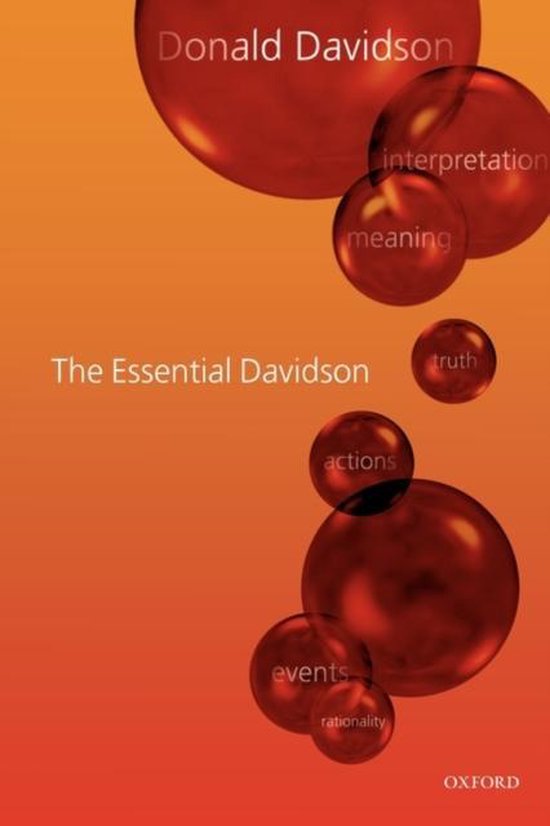
Compiling the celebrated papers of one of the twentieth century's greatest philosophers, this volume distils Donald Davidson's seminal contributions to the understanding of language, the mind, action, and knowledge. It is useful for those seeking a reference point for some of the most brilliant and influential academic writing of modern times.
The Essential Davidson compiles the most celebrated papers of one of the twentieth century's greatest philosophers. It distils Donald Davidson's seminal contributions to our understanding of ourselves, from three decades of essays, into one thematically organized collection. A new, specially written introduction by Ernie Lepore and Kirk Ludwig, two of the world's leading authorities on his work, offers a guide through the ideas and arguments, shows how they interconnect, and reveals the systematic coherence of Davidson's worldview. Davidson's philosophical program is organized around two connected projects. The first is that of understanding the nature of human agency. The second is that of understanding the nature and function of language, and its relation to the world. Accordingly, the first part of the book presents Davidson's investigation of reasons, causes, and intentions, which revolutionized the philosophy of action. This leads to his notable doctrine of anomalous monism, the view that all mental events are physical events, but that the mental cannot be reduced to the physical. The second part of the book presents the famous essays in which Davidson set out his highly original and influential philosophy of language, which founds the theory of meaning on the theory of truth. These fifteen classic essays will be invaluable for anyone interested in the study of mind and language. Fascinating though they are individually, it is only when drawn together that there emerges a compelling picture of man as a rational linguistic animal whose thoughts, though not reducible to the material, are part of the fabric of the world, and whose knowledge of his own mind, the minds of others, and the world around him is as fundamental to his nature as the power of thought and speech itself.
Bekijk ook eens deze gerelateerde producten.