Ontvang een e-mail bij een prijsdaling tot onder je gewenste prijs.
Je ontvangt een e-mail wanneer de prijs daalt.
We volgen de prijsontwikkeling van dit product op bol.com (Nederland).
Macroeconomics: A European Perspective Blanchard, Amighini, Giavazzi 3rd edition “This is a truly outstanding textbook that beautifully marries theory, empirics and policy. It is surely destined to become the gold standard against which all other texts must be measured” Charles Bean, Deputy Governor, Bank of England. This book gives students a thorough understanding of macroeconomics by taking a unified view of the subject, allowing connections to be made between the short, medium and long run. Re-written almost from scratch in light of the experience of the Great Recession, this text is essential reading for anyone studying macroeconomics in the aftermath of the financial crisis. The book has been re-written almost from scratch after a thorough re-think of how macroeconomics should be taught after the financial crisis. Among the new features: · The text recognizes that modern central banks set interest rates, not the quantity of money: this gets rid of the LM curve greatly simplifying the discussion of financial markets · Ii presents the Medium Run starting directly from the Phillips curve, thus avoiding the intermediate AS-AD step which was clunky, and, for good reasons, undergraduates find it difficult to understand. Output above potential, or unemployment below the natural rate put upward pressure on inflation. The nature of the pressure depends on the formation of expectations, an issue central to current developments · The yield curve now incorporates a risk premium, whose fluctuations have been central to the crisis, especially since Quantitative Easing policies have shown that monetary policy can affect this premium Olivier Blanchard studied at the University of Paris, Nanterre, and has taught at MIT since 1983. He was chief economist at the International Monetary Fund from 2008 to 2015. He is now a Senior Fellow at the Peterson Institute for International Economics. Francesco Giavazzi is Professor of Economics at Bocconi University in Milan, and has been a regular Visiting Professor at MIT Alessia Amighini is Assistant Professor of Economics at Universita’ del Piemonte Orientale (Novara)
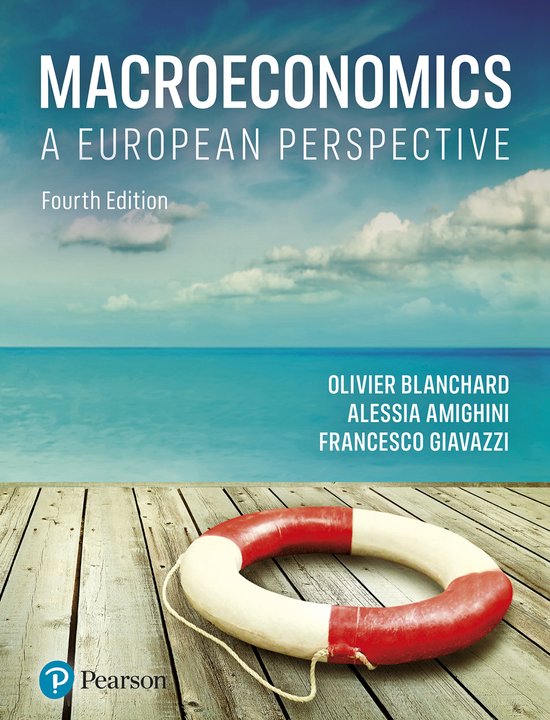
“This is a truly outstanding textbook that beautifully marries theory, empirics and policy. It is surely destined to become the gold standard against which all other texts must be measured” Charles Bean, Deputy Governor, Bank of England. This book gives students a thorough understanding of macroeconomics by taking a unified view of the subject, allowing connections to be made between the short, medium and long run. Re-written almost from scratch in light of the experience of the Great Recession, this text is essential reading for anyone studying macroeconomics in the aftermath of the financial crisis. The book has been re-written almost from scratch after a thorough re-think of how macroeconomics should be taught after the financial crisis. Among the new features: · The text recognizes that modern central banks set interest rates, not the quantity of money: this gets rid of the LM curve greatly simplifying the discussion of financial markets · Ii presents the Medium Run starting directly from the Phillips curve, thus avoiding the intermediate AS-AD step which was clunky, and, for good reasons, undergraduates find it difficult to understand. Output above potential, or unemployment below the natural rate put upward pressure on inflation. The nature of the pressure depends on the formation of expectations, an issue central to current developments · The yield curve now incorporates a risk premium, whose fluctuations have been central to the crisis, especially since Quantitative Easing policies have shown that monetary policy can affect this premium Olivier Blanchard studied at the University of Paris, Nanterre, and has taught at MIT since 1983. He was chief economist at the International Monetary Fund from 2008 to 2015. He is now a Senior Fellow at the Peterson Institute for International Economics. Francesco Giavazzi is Professor of Economics at Bocconi University in Milan, and has been a regular Visiting Professor at MIT Alessia Amighini is Assistant Professor of Economics at Universita’ del Piemonte Orientale (Novara)
Bekijk ook eens deze gerelateerde producten.