Rain of Ruin · bol.com prijsdaling melding

Boek

Rain of Ruin

Huidige prijs op bol.com (Nederland)

Maak een prijsalert aan

Ontvang een e-mail bij een prijsdaling tot onder je gewenste prijs.

€
-5% € 26,84
-10% € 25,43
-15% € 24,01

Je ontvangt een e-mail wanneer de prijs daalt.

Prijsgeschiedenis

We volgen de prijsontwikkeling van dit product op bol.com (Nederland).

Er is nog geen prijsgeschiedenis grafiek beschikbaar. Kom op een later moment terug.
Laatste update: 16 November 2026
Huidige prijs: € 28,25
Rain of Ruin

Rain of Ruin

Bekijk op bol.com

Productinformatie

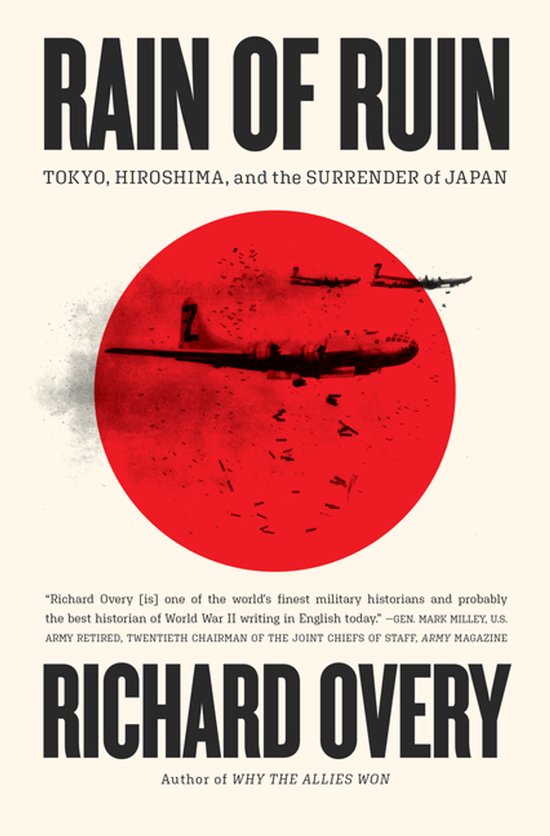
A leading historian of World War II sheds new light on the purposes and impact of the U.S. incendiary and atomic bombing of Japan’s cities in 1945.

Praise for Richard Overy

Blood and Ruins

"[A] stupendous achievement…Blood and Ruins dissects the sinews of war with the sharpest of scalpels…It is history at its best, down to the finest points."
— Josef Joffe, New York Times Book Review

"Blood and Ruins is a monumental work…Richard Overy has given us a powerful reminder of the horror of war and the threat posed by dictators with dreams of empire."
— Michael F. Bishop, Wall Street Journal

"The Pacific clash over colonies reveals a greater truth about the Second World War…[Blood and Ruins] refuses to treat the Pacific as ‘an appendix,’ as histories often do. Rather, it sees World War II as a truly 'global event.'"
— Daniel Immerwahr, The Atlantic

The Dictators

"Gripping…astonishing…superb. [Overy’s] skills lie in the fluent telling of a complex story, in the sharp flash of insight, in his patient commitment to the rational explanation of events that sometimes seem to defy all reason."
— Jane Caplan, Times Literary Supplement

Why the Allies Won

"Clear-sighted…learned, and multifaceted."
— Richard Bernstein, New York Times

"Broad and insightful."
— Eliot A. Cohen, Foreign Affairs

"A masterpiece of analytical history."
— Niall Ferguson, Sunday Times (London)


With the development of the B-29 “Superfortress” in summer 1944, strategic bombing, a central component of the Allied war effort against Germany, arrived in the Pacific theater. In 1945 Japan experienced the three most deadly bombing attacks of the war. The firebombing of Tokyo in March burned the city’s most densely populated sector, killed some 85,000 residents, and left more than one million homeless. The attack was part of a months-long campaign of incendiary bombing that destroyed almost two-thirds of Japan’s cities. The two atomic blasts in August killed hundreds of thousands in Hiroshima and Nagasaki, most of them civilians. The bombing brought a destabilizing devastation that, combined with a declaration of war by the Soviet Union, induced Japan, as they put it, to terminate the war. Many at the time and since have credited American air power, and especially the two atomic bombs, with Japan’s surrender. But Richard Overy tells a different, more dimensional story. Drawing on his expertise on the war and its bombing campaigns, he delivers a precise recounting of these aerial attacks, and a balanced, informed assessment of how and why they occurred. Overy is astute on the Allied decision-making, and, notably, integrates the Japanese leadership as well. He ably navigates the dramatic endgame of the war, which featured factional infighting within the Japanese cabinet, a scramble by American officials to formulate an acceptable version of “unconditional surrender,” and the crucial role played by the emperor, Hirohito. The atomic bombing emerges as impactful but not decisive in this rich, multilayered history

Toon meer

Aanbevolen producten

Bekijk ook eens deze gerelateerde producten.